
Alabaster Directory Collections by Year
No single verified run bears only the Alabaster name. The strongest dated series is the Greater Shelby County telephone sequence held by the Library of Congress. Annual issues are verified from 1974 through 1980, including a fully digitized July 1978 volume. The Alabama Department of Archives and History, or ADAH, holds broader Birmingham suburban titles and three dedicated Shelby County volumes. Their titles are promising, but the locality lists must be checked before claiming that every issue includes Alabaster.
| Collection | Years | Where Held | Access |
|---|---|---|---|
| Greater Shelby white pages | 1974-1980 annual sequence | Library of Congress | 1978 online; related issues digitized or on microform |
| Birmingham suburban directories | 1965-1994, with gaps | ADAH LPR104 | Research room; Alabaster coverage needs inspection |
| Shelby County directories | 2000-2002 | ADAH LPR104 | Research room |
| Census schedules | Public through 1950 | NARA and library databases | Free federal access or licensed database |
| Obituary, cemetery, will, and court indexes | Coverage varies | Shelby County Historical Society | Online indexes and onsite originals |
The research did not verify the publisher of the ADAH Shelby set, the first dedicated Alabaster volume, or a final printed year. It also found no Alabaster or Siluria Sanborn fire-insurance map. Those gaps should remain gaps. A collection title is not proof that a person or town appears inside it.
Alabaster Directory in Greater Shelby
The Library of Congress July 1978 Greater Shelby County volume contains 439 images. Related catalog records establish issues for June 1974, June 1975, July 1976, July 1977, September 1979, and August 1980. That dated sequence is more useful than an undated surname hit because it lets a family historian test whether a subscriber appears, vanishes, or changes address from one year to the next.
A Greater Shelby title still requires an inside check. Open the cover, title page, locality list, and abbreviation key before hunting a name. Locate an Alabaster or Siluria heading, if present, and record the listing exactly. The research did not inspect an individual Alabaster entry, so it would be wrong to promise spouse names, occupations, owner marks, or other features common to some city directories.
Telephone books record listed accounts. A missing person may have used another household member’s account, kept an unlisted number, moved, or fallen outside that issue’s locality coverage. Search initials and spelling variants before drawing a conclusion.
Read Alabaster Directory Evidence Safely
An entry should be copied as printed before it is interpreted. In the verified Greater Shelby source, the safe inventory is narrower than the classic city-directory model. The record can support a subscriber name and may show address and telephone details, but the precise format must be checked on the image. Do not import fields from an unrelated publisher.
| Place heading | Confirms the locality section in which the listing was printed. |
|---|---|
| Subscriber name | Shows the listed account name, including initials or suffixes as printed. |
| Address text | May supply a street clue; retain every abbreviation and direction. |
| Telephone | Links the listed account to that issue, not every person in the home. |
| Volume date | Places the clue in a publication period rather than proving an exact move date. |
Photograph or save the title page and abbreviation key with the listing. Without those pages, a later reader cannot tell whether a mark was part of the publisher’s system or a guess added during transcription.
- Criss-cross directory
- A directory arranged by street address or telephone number rather than only by surname.
- Householder index
- An address-based list naming the person identified as the household contact in that source.
- Abbreviation key
- The publisher’s own list explaining shortened street, place, and entry terms.
- Telephone subscriber
- The person or party under whose name a listed telephone account appeared.
Alabaster Directories at ADAH
The ADAH LPR104 finding aid describes 242 boxes of Alabama city directories dated from 1837 to 2006. Its Birmingham suburban titles include 1965-1969, 1976-1980, 1982-1984, 1989, and 1991-1994. It separately lists Shelby County directories for 2000, 2001, and 2002. The finding-aid order is irregular, so a reader should use the stated year and box information rather than assume a clean annual run.
Ask archive staff to inspect the title page and locality list before a trip. The key question is not merely whether a suburban volume exists. It is whether that edition covers Alabaster, Siluria, or the relevant Shelby community. If it does, request any street-address or criss-cross portion as well as the alphabetical section. If not, move to the county telephone run, census, and local indexes.
For 1976-1995 gaps, Library of Congress staff can also retrieve phonefiche arranged by state and city. Their directory guidance recognizes street address, criss-cross, telephone book, and city business formats. Format matters because an alphabetical white-pages issue cannot be searched honestly as an address-sorted roll.
Note: Verify the locality list before citing any Birmingham suburban volume as an Alabaster city directory.
Alabaster Directory Database Routes
Albert L. Scott Library genealogy resources divide access by product. HeritageQuest is available remotely with a Shelby County library card. Ancestry Library Edition is limited to library computers. Newspapers.com Library Edition Southeast is an onsite or library-access source, while FamilySearch and links to ADAH and Birmingham Public Library Southern History widen the search.
The card is free to Shelby County residents. Nonresidents pay $30 per year unless they work or attend school in the county. Scott Library is at 100 Ninth Street NW and can be reached at 205-664-6822. Its public resource page does not inventory old telephone books, reverse directories, local yearbooks, or obituary shelves, so call before making a special trip.
A new library of about 19,000 square feet, nearly triple the current space, remained under construction through 2026. That project may change the address, hours, database stations, or local-history storage after the research date. Date-check access with staff rather than treating a construction announcement as proof that new genealogy holdings are already open.
Alabaster Names Beyond Directories
The Shelby County Historical Society archive is the best documented local fallback when a directory year is absent. At the Old 1854 Courthouse in Columbiana, its indexes and originals span marriages, estates, county record books, cemeteries, wills, surnames, loose court papers, obituaries, divorces, oral histories, and a patron library. The research room is open Tuesday through Friday, 9 a.m. to 3 p.m.; call 205-669-3912 or email schs1854@bellsouth.net to confirm a series and retrieval needs.
The archive’s Armchair Archivist project transcribes early wills, estates, deeds, and loose court papers. Its Datcher index references more than 3,500 enslaved people from records beginning in 1818. That work directly addresses the pre-1870 African American genealogy gap, where a telephone directory cannot help and a federal census may omit a surname or family tie.
The Shelby County Historical Society archive and index page is the starting point for checking those record groups.
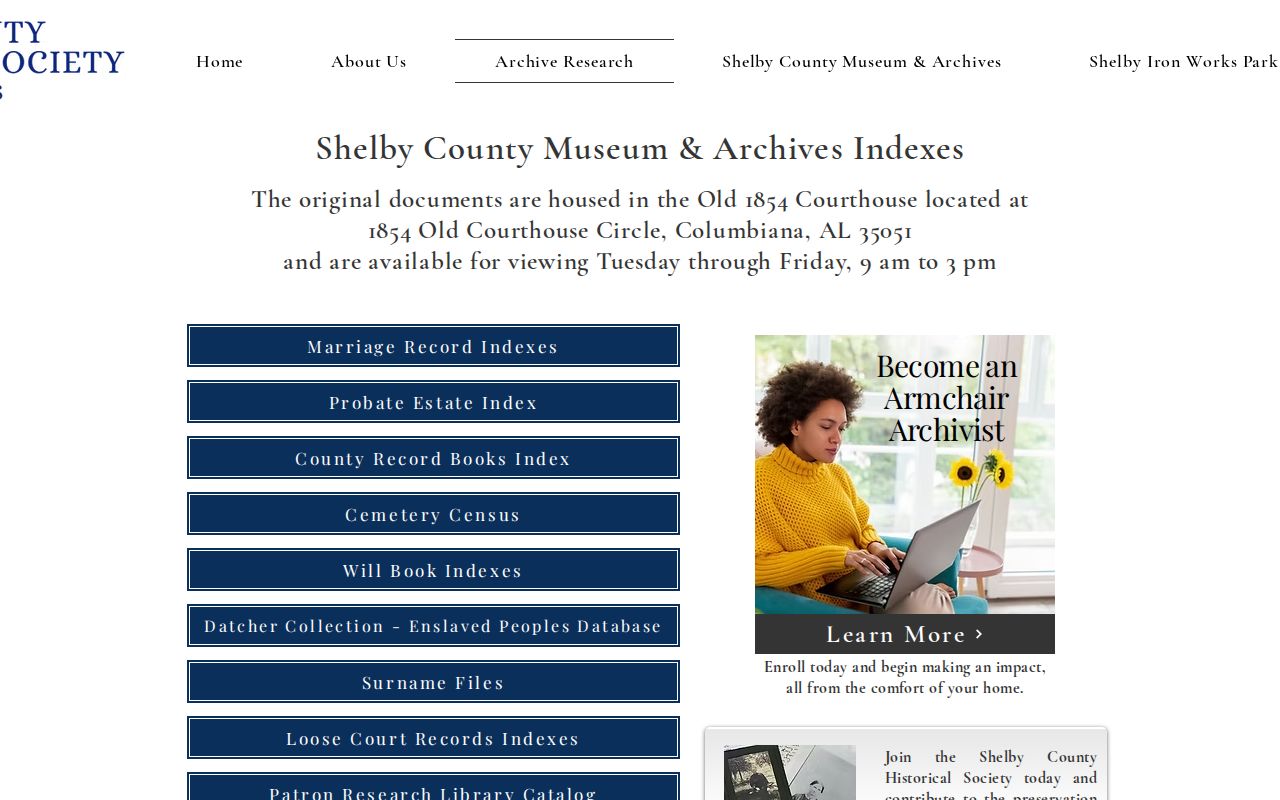
The archive index helps identify a record series and citation. Staff or the original document can then confirm the person-level facts.
Alabaster’s First Resident List
Alabaster’s incorporation history offers a rare local resident source outside the usual city directory shelf. A 1952 petition carried 73 electors. After the first planned election was vacated on a technical point, the petition was filed again in January 1953. The February vote was 79 to 23, and the incorporation record names 427 inhabitants. Alabaster incorporated on April 25, 1953.
| Date | Directory and Place-Name Clue |
|---|---|
| Early 1920s | The Alabaster Lime Company community forms before city incorporation. |
| 1951 | The Alabaster post office establishes a newer local place label. |
| 1953 | Incorporation papers name 427 inhabitants. |
| 1971 | The Siluria merger makes both place names important to searches. |
| 1974-1980 | The verified Greater Shelby annual telephone sequence spans seven issues. |
| 2000-2002 | ADAH lists three dedicated Shelby County directory volumes. |
Request the petition, election orders, and inhabitant schedule from the Alabaster City Clerk or the relevant Shelby court custodian. The schedule may be the most focused list of early Alabaster residents, but it should be cited as an incorporation record, not described as a commercial city directory. Keep the original spelling and any household grouping.
Siluria joined Alabaster in 1971. Historic searches should therefore repeat a name under Alabaster, Siluria, and broader Shelby County labels. The old mill community dates to the Alabaster Lime Company era of the early 1920s, while the post office arrived in 1951. Place names changed as the city formed.
Trace Alabaster Directory Families
A sound Alabaster city directory search uses each book as one dated observation. Census schedules are public through 1950 under the 72-year rule. Pair the directory just before and after a census with the census household, then use obituaries, probate, or deeds for later confirmation. This method separates a true move from a missing issue or an unlisted telephone.
- Choose a known year, full name, and place label. Check Alabaster, Siluria, Maylene, and Shelby County when the date or address calls for them.
- Inspect the volume’s title page, place list, and key. Save those pages with the exact listing.
- Search the prior and next available issue. Note changes, but do not treat a one-year absence as proof of death or departure.
- Pair the directory clue with the nearest public census through 1950. Use the census to test household relationships.
- Close the trail through SCHS obituary, cemetery, will, estate, or court indexes, then obtain the original record when needed.
A reader focused on current address-keyed ownership should switch to the Alabaster street directory workflow. Historical city directories answer a different question: what a dated publication or archive listed at that time. Both are clues, and neither alone proves everyone who occupied a home.
Note: A vanished listing can reflect a move, death, omitted issue, unlisted telephone, changed place heading, or indexing error.