
Alabaster Resident Records by Era
Previous residents become visible through sources with different dates and purposes. The strongest first source depends on the period. Deeds support a long ownership chain, annual telephone books create closer snapshots in the 1970s, and the census supplies household relationships through its latest public year.
| Source | Years it covers | Where held | What it shows |
|---|---|---|---|
| Recorded deeds | 1819 to present stated online | Shelby Probate and ROAM | Parties, instrument, book/page, and legal ownership chain |
| Greater Shelby white pages | 1974 to 1980 annual sequence | Library of Congress | Listed name, address, and telephone snapshots |
| Shelby County directories | 2000 to 2002 | Alabama Department of Archives and History | County directory snapshots; local coverage requires inspection |
| Federal census | Public through 1950 | NARA and library databases | Household composition and relationships |
| Permits and inspections | Start date not published | Alabaster Building by request | Construction, alteration, and inspection milestones |
| Probate and obituary files | County records begin in the 1818 era; index years vary | Shelby Probate and SCHS | Death, estate, heir, and family endpoints |
For a modern Alabaster address, start with the parcel and its current deed. For a mid-century household, begin near the census or telephone date and use the deed chain to test whether the listed person owned the property. Missing years should stay visible rather than being filled with assumptions.
Start Alabaster Previous Residents Today
The backward trail begins in Shelby County GIS. Enter the exact address, choose the Address suggestion, and open its parcel. Record the parcel number, boundary, deed link, and any legal or subdivision reference that can carry the search beyond a modern street label.
The assessed owner is a starting name, not proof of residence. A business, trustee, estate, or person using a different mailing address may hold title. Likewise, the current address may cover land once described only by lot, block, subdivision, or metes and bounds. That legal description is often more stable than the house number.
The full current street workflow, including GIS shape tools, belongs in the Alabaster street directory. A previous-resident search uses one parcel as a fixed point and moves backward one recorded transfer at a time.
Reverse Alabaster Resident Deed Records
ROAM indexes Shelby County recorded instruments by party and record identifiers rather than street address. The current parcel supplies the first deed link. From there, the seller on one purchase can become the grantee, meaning buyer, in the prior transaction.
- Open the current parcel and save its legal description, parcel number, deed instrument, or book and page.
- Find the current owner's purchase deed in Shelby County ROAM. Confirm the property through the record identifiers, not a name alone.
- Take the seller, or grantor, and search that party as an earlier grantee. Narrow by date, deed type, book/page, and spelling variants.
- Repeat the seller-as-earlier-buyer step. Keep a dated log of each instrument and note any break in the chain.
- When an image, cancellation, or annotation is absent, move to Probate Recording Room A401 and the official books.
Search modes include Starts With, Contains, Exact, and Phonetic. The index also offers instrument, recording dates, first and last names, document type, book/page, and map book/page. Broad deed categories and name variants are safer than treating one empty search as final.
Decode Alabaster Resident Property Terms
Three terms keep a previous residents trail anchored to the right land. They also help explain why a person may appear in the index without having occupied the address.
- Grantor and grantee
- The grantor transfers an interest; the grantee receives it. In a standard purchase deed, that often means seller and buyer.
- Chain of title
- The linked sequence of recorded transfers affecting the same property. It tracks legal ownership, not every occupant.
- Legal description
- The recorded identification of the land, often by lot, block, subdivision, or survey terms. It can outlast a changed street name.
- Instrument
- A recorded document such as a deed, mortgage, release, easement, lien, or plat, identified in the probate index.
A map or plat can reconnect an old legal description to the present parcel. When the owner name changes but the land description holds, the record trail is usually stronger than a match based only on a surname.
Alabaster Resident Deeds Beyond Screens
Shelby County says deeds from 1819 to the present are viewable online, giving Alabaster address research an unusually long indexed path. Yet ROAM states that the records room is the complete official repository. Some old mortgage cancellations do not have electronic images and remain in the books.
The county recorded-instrument index below is the public search route for that deed trail.
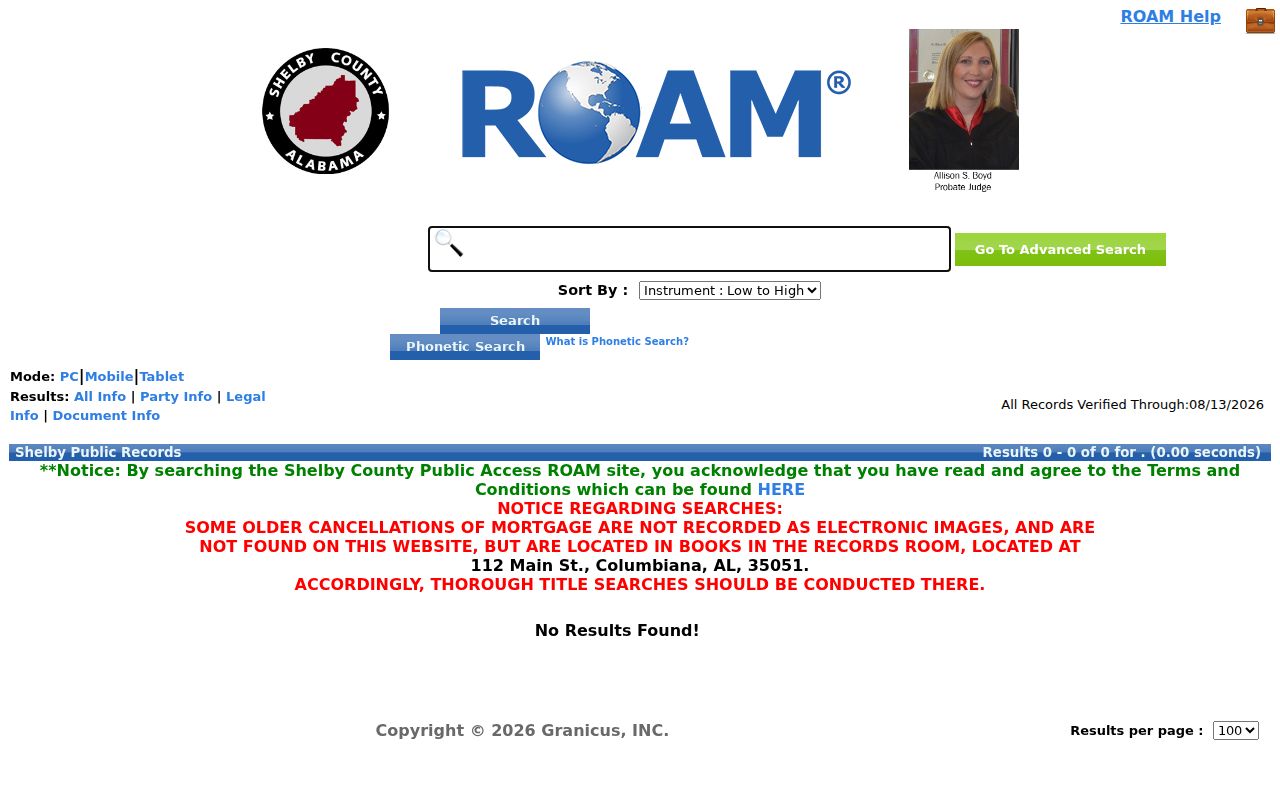
The form supports several ways to reconnect a broken address history, including party, instrument, date, document type, and book/page searches. Legacy labels and typographical variants make a second query worthwhile.
Probate Recording is in Room A401 at 112 North Main Street in Columbiana, with telephone help at 205-670-5220. Copies are listed at $1 per page. Historical transcriptions say most records were rescued during an 1891 courthouse fire, though some probate or collector material may have been lost. Bring exact identifiers and ask whether a gap is an unindexed book, a missing image, a separate instrument family, or a true series loss.
Match Alabaster Directories to Census
Deeds identify owners. They do not recover every previous resident. The verified Greater Shelby white pages run annually from 1974 through 1980, and the July 1978 digitization contains 439 images. These volumes can identify a listed subscriber, address, and telephone number at a point in time.
Pair directory and census evidence in a fixed sequence:
- Inspect the volume's title page, locality list, and abbreviation key before assuming Alabaster or Siluria coverage.
- Copy the listing exactly, including initials, suffixes, street abbreviation, and telephone format.
- Check the issues just before and after it. A one-year absence may reflect an unlisted phone, a move, or an indexing problem.
- Compare public census schedules through 1950 for household relationships, then use deeds, probate, or obituaries to test identity.
A white-pages volume is not automatically arranged by address. Use it as a reverse directory only when an actual criss-cross or street section is present. Collection details and access choices appear in the Alabaster city directory.
Bridge Alabaster Resident Place Names
An address can remain in place while its governmental or postal label changes. Alabaster incorporated in 1953 and merged with Siluria in 1971. Earlier records may use Siluria, rural Shelby County, a subdivision name, or survey language. A parcel later annexed into Alabaster may also retain a Maylene postal identity.
Search the historically plausible place names, but do not assume they are interchangeable. The deed's legal description, recorded plat, and parcel boundary should supply continuity. Exact USPS address lookup can verify the current postal line, while GIS and annexation records address city jurisdiction.
No authoritative citywide renumbering date or street-name crosswalk was found. The research also located no verified Alabaster or Siluria Sanborn fire-insurance map. Those gaps should be stated. A nearby town's map is not a substitute for an Alabaster address.
Date Alabaster Resident Addresses with Permits
Alabaster does not publish a verified historical permit index by address. Building and Engineering directs house permit and inspection research through a city public-record request. Give the exact street address, a narrow date span, and the requested permit, inspection, or certificate-of-occupancy records.
A permit can date an addition, repair, or construction event. The applicant or named owner may still differ from the household. Use the milestone to explain a change in the property, then return to directories, census, deeds, or obituaries for person-level evidence.
City requests may be sent in person, by fax, email, courier, or mail. The policy allows clarification, prepayment, or a deposit and lists regular inspection access. No published permit coverage start was found, so requesters should ask whether older files remain with the city or another custodian.
Note: A narrow date band and named file type make an Alabaster address request easier to identify and less costly to process.
Close Alabaster Resident Trails at Probate
A name often disappears from an address after death, transfer to heirs, or an estate sale. Shelby Probate Judicial records and the Shelby County Historical Society's obituary, will, estate, cemetery, marriage, divorce, and loose-court indexes can clarify that endpoint. Probate estate information is not offered through a public remote inquiry, so the counter or telephone is the main route.
The Shelby County Historical Society archive keeps indexes and originals at the Old 1854 Courthouse. Its published access hours are Tuesday through Friday, 9:00 a.m. to 3:00 p.m., with telephone help at 205-669-3912. Ask about year coverage, advance retrieval, and copy or research charges before relying on an online index alone.
The image below shows the authoritative research entry point for these local collections.
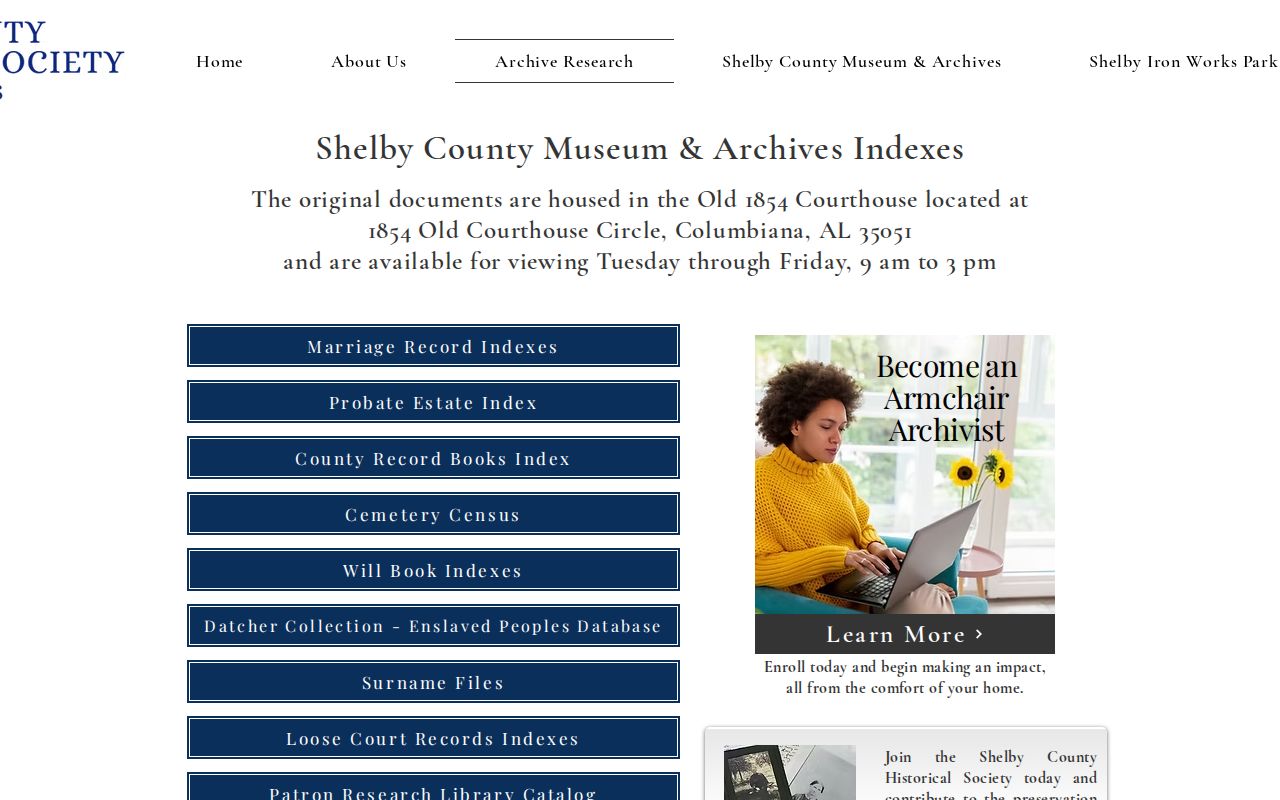
Indexes lead to records; they are not replacements for the originals. A will, estate file, obituary, or cemetery entry should be tied back to the same person with dates, relatives, and property details.
Judge Alabaster Past Resident Evidence
Previous residents can be supported at several levels. A deed proves a recorded property interest. A census names a household at an enumeration date. A telephone book records a listed account. A permit marks work on the site. Probate and obituary records may connect the person to relatives, an estate, or a former place.
None of those sources alone proves every member of an Alabaster household. Children, relatives, renters, unlisted subscribers, and short-term occupants may be absent. The sound conclusion names the source and date: a person held title, appeared as a listed subscriber, or belonged to a census household. It avoids turning that clue into a claim about all years.
Can an ownership gap be filled with a directory name? Only as an occupant clue. Keep the deed chain and household trail separate until two dated records connect the same person, land, and period.
Lawful use. Research Alabaster previous residents for house history, genealogy, heirs, or personal curiosity. Never use the trail to stalk, harass, track, or harm a living person.